
 English
 Dutch
Dutch Japanese
 Hindi
Hindi Italian
 Spanish
 French
 German
 Chinese
 Korean
 Arabic
 Hebrew
 Russian
 Portuguese
 Danish
 Czech
Czech Polish
 Swedish
Max. Altitude
6,145 meters (20,161 feet)
Best Season
Spring
Start / End Point
Kathmandu
Overview of Lobuche West Peak Climbing
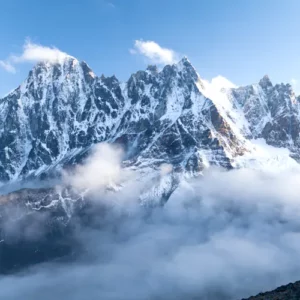
The Lobuche West Peak Climbing journey is set in the Khumbu region where Sherpa communities have thrived for 500 years after migrating from Tibet’s Kham province. We trek through Sagarmatha National Park’s 1148 square kilometers of glacial terrain established as a UNESCO site in 1979. Your journey begins at Lukla’s 527-meter runway where Tara Air planes land on a mountainside strip. You pass Pangboche village at 3,930 meters home to Nepal’s oldest monastery and the sacred Pangboche Hand relic. Dughla’s stone stupa marks the resting place of fallen climbers with mani stones inscribed in Tibetan script.
Lobuche West stands at 6119 meters, just 3 kilometers west of Everest Base Camp, requiring technical skills on 50-degree ice walls above 5,900 meters. As per safety protocols, we mandate fixed rope use on glaciated sections near Lobuche West Base Camp icy fields where crevasse fall risk is higher without proper roping. You cross the Ngozumpa Glacier, Nepal’s longest at 36 kilometers, en route to Gokyo Lakes’ turquoise waters reflecting Cho Oyu’s 8,188-meter summit. This is an optional detour, not a part of the standard itinerary. Machhermo’s Himalayan Rescue Association clinic monitors your oxygen saturation using protocols developed recently. Teahouses in Namche Bazaar sell roasted barley snacks and charge $1 per liter for boiled water above 4,000 meters. This climb tests your mountaineering skills while connecting you to the living culture of the world’s highest mountains.
We handle every detail so you can focus solely on summiting. Your guide checks oxygen saturation, we secure Lukla return seats after completing the trek, and at the start of the journey. Our strong porters carry 15kg loads freeing you for technical sections like Cho La’s ice wall. All your transportation needs are arranged before you even arrive in Nepal. As your trekking partner, Life Himalaya Trekking arranges all the major aspects of the trek to make sure that your journey to the Himalayas is as seamless as possible.
Highlights of Lobuche West Peak Climbing
- Summiting Lobuche West Peak at 6119 meters with Everest visible to the west
- Crossing the Cho La Pass ice wall at 5,420 meters using fixed ropes
- Navigating Khumbu Glacier’s icefall with rope teams near Lobuche Base Camp
- Crossing the Hillary Suspension Bridge’s metal grating over the Dudh Koshi River at 3,800 meters
- Climbing Gokyo Ri’s final 200 meters on 45-degree scree before sunrise
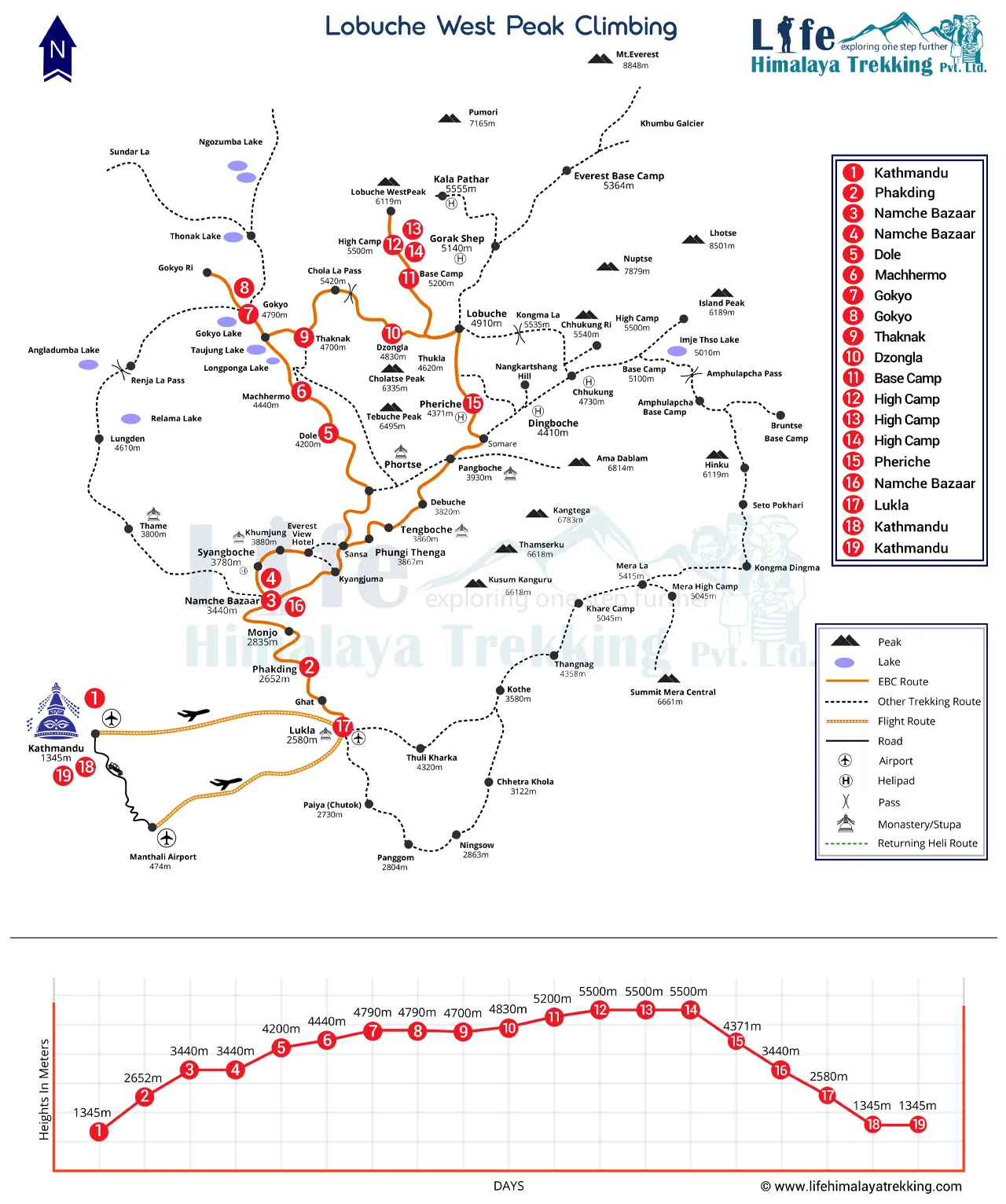
Lobuche West Peak Climbing Itinerary
01
Arrival in Kathmandu, transfer to the hotel
The first day of the Lobuche West Peak Climbing journey starts after we land in Kathmandu. The maximum altitude is 1,400 meters, with no trek, just arrival and transfer. You touch down at Tribhuvan International Airport and our team meets you at arrivals. We handle your bags and drive you to your hotel in Thamel or nearby. The ride takes 30 to 45 minutes since traffic can slow us down. After reaching the hotel, you check in, recover from the flight, and stretch your legs.
You can also walk around Thamel if you feel up to it. Maybe grab a plate of momo, drink some local specialty. Before heading to bed, sort your gear and we’ll arrange a meeting with your guide tomorrow morning. We will brief you on the climb, and you need to pack essentials in your daypack.
Maximum Altitude
1400
02
Fly to Lukla and trek to Phakding
On the following day of the Lobuche West Peak Climbing journey, we fly early from Kathmandu to Lukla. The flight takes 35 minutes and we land at Tenzing Hillary Airport. The runway is short and steep, making it kind of thrilling and exciting. We start trekking after landing and the trail drops from 2,860m to 2,610m. We lose 250 meters in elevation while the walk takes 3 to 4 hours. The total distance of the day is around 8 kilometers, following the Dudh Koshi River, ascending stone steps, crossing suspension bridges, and traversing pine forests.
We pass small teahouses in villages like Chheplung and Ghat. The trail is easy after the flight, a rather good way to warm up legs. We reach Phakding by afternoon and rest by the river or in the teahouse. Tomorrow we have a long climb to Namche.
Maximum Altitude
2,610 m
Meals
Breakfast, Lunch & Dinner
Accomodations
Teahouse
Transportation
35 mins
03
Trek to Namche Bazaar
On Day 3 of the Lobuche West Peak Climbing journey, we leave Phakding early. We cross several suspension bridges over the Dudh Kosi River and pass through small Sherpa villages like Toktok, Monjo, Jorsalle, and more. After Monjo we enter Sagarmatha National Park; there is a check-post for permits. We walk about 10-11 km overall and ascend roughly 830 meters of net elevation gain from about 2610 m at Phakding to 3440 m at Namche Bazaar. We spend 6-7 hours trekking, including breaks and photo stops.
Trail conditions shift during the day. The first part is gentler, with mixed terrain alongside the river, forested paths, and gradual climbs. Then after Jorsalle, the trail steepens, especially the final 1-2 hours, which feature steep steps, switchbacks up through pine/rhododendron forest. Lunch break is usually in Jorsalle, the tea houses there supply food, hot drinks.
As we climb up, the views grow better steadily, of snow peaks, valley panoramas, river gorges, and forests. We arrived in Namche Bazaar by late afternoon, where the local Sherpa culture, cozy shops, and aesthetic views await us.
Maximum Altitude
3,440 m
Meals
Breakfast, Lunch & Dinner
Trek Duration
6-7 hrs
04
Acclimatization in Namche, hike to Everest View Hotel/Khumjung
The next day of the Lobuche West Peak Climbing journey is an acclimatization day, so we stay in Namche. The town sits at 3,440 meters and a rest day here helps us adapt before moving higher. We keep active by hiking above Namche, gaining altitude during the day, then returning to sleep lower. This routine supports safe acclimatization.
Our main goal is Hotel Everest View at 3,880 meters. The hike takes around 3 to 4 hours round-trip. We climb about 440 meters and cover 3 to 4 kilometers each way. The path begins with stone steps and passes prayer walls and mani stones. We reach Syangboche, an old airstrip, then follow a steeper trail toward the hotel. At the terrace, we stop for tea and enjoy clear views of Everest, Lhotse, Ama Dablam, and the surrounding peaks.
Many trekkers extend the hike to Khumjung village below the hotel. There you can visit the Khumjung monastery and Hillary School before walking back to Namche. By mid-afternoon we return to our lodge, leaving time to rest, explore shops, or visit the Sherpa museum.
Meals
Breakfast, Lunch & Dinner
05
Trek to Dole
We start Day 5 of the Lobuche West Peak Climbing journey in Namche Bazaar at 3,440 meters. Today, you have to hike 11 kilometers northeast toward Dole, gaining almost 600 meters over 5 to 6 hours. The trail follows a rocky high-altitude route with minimal vegetation. You cross glacial streams via narrow bridges and pass yak grazing areas used by Sherpa herders. Dole sits at 4038 meters with basic teahouses offering simple meals and shelter. The elevation gain demands steady breathing and frequent hydration checks. We recommend setting a slow pace to manage thinning air.
This segment builds stamina for the 4,470-meter climb to Machhermo the next day. You should watch for altitude symptoms like headaches during the final ascent. The terrain tests balance on uneven stones, requiring focused footing. We stop for short rests every 45 minutes or so to acclimatize properly. Dole’s stone shelters provide essential recovery space before tomorrow’s steeper climb.
Maximum Altitude
4,038 m
Meals
Breakfast, Lunch & Dinner
Trek Duration
5-6 hrs
06
Trek to Machhermo
Leaving Dole at 4038 meters after breakfast, we have a 7-kilometer trek to Machhermo, which takes about 4 to 5 hours with a 432-meter elevation gain. You follow a narrow path along the Bhote Koshi River. The trail crosses glacial streams on wooden bridges and traverses rocky moraines left by retreating glaciers. We pass small Sherpa settlements with prayer flags flapping in the wind. The air thins noticeably above 4,300 meters. Machhermo sits at 4,470 meters with stone houses and a high-altitude medical clinic run by the Himalayan Rescue Association.
The teahouses there offer hot meals and basic lodging, all a part of the Lobuche West Peak Climbing package. We check oxygen levels before bed and after waking up, using portable pulse oximeters. We will take ten-minute rests every hour to adjust to the altitude. You might feel mild headaches indicating early altitude effects. You can simply adjust your pace if breathing becomes labored. Machhermo’s clinic provides emergency support for severe symptoms. Store extra layers in your daypack for sudden temperature drops.
The final ascent tests endurance with loose scree sections. We will reach Machhermo by early afternoon to maximize acclimatization time. Your guide monitors group speed to maintain safe oxygen saturation levels. Track your water intake since dehydration worsens altitude symptoms above 4,000 meters.
Maximum Altitude
4,470 m
Meals
Breakfast, Lunch & Dinner
Trek Duration
4-5 hrs
Accomodations
Teahouse
07
Trek to Gokyo
On the 7th day of the Lobuche West Peak Climbing journey, we depart Machhermo at around 7 AM for the 4 to 5-hour trek to Gokyo. We will cover 6 to 7 kilometers while gaining 320 meters to reach 4,790 meters. The trail descends slightly alongside the Ngozumpa Glacier’s lateral moraine. We cross three glacial streams using sturdy log bridges early in the hike. The path then climbs steadily through scree slopes with panoramic glacier views. You spot turquoise Gokyo Lakes emerging below around hour three. Your guide checks oxygen saturation levels every so often above 4,600 meters.
Gokyo village clusters near the third lake with about 20 stone teahouses and prayer wheels at the shore. Most trekkers drink ginger tea and garlic soup at Lake Dudh Pokhari to combat altitude effects. Carry trekking poles for the loose moraine sections; they reduce knee strain significantly. There are extra oxygen cylinders at the Gokyo clinic for emergencies. We stop for 15-minute rests at each lake viewpoint for photo opportunities and acclimatization. The trek guide keeps you off the hidden crevasses near the glacier edge; staying on marked trails. You will reach Gokyo by 1 PM to allow time for lake exploration before dinner.
Meals
Breakfast, Lunch & Dinner
Trek Duration
4-5 hrs
08
Acclimatization in Gokyo, climb Gokyo Ri
We begin Day 8 of the Lobuche West Peak Climbing journey at around 3 AM for Gokyo Ri’s summit push. You climb 567 meters from Gokyo’s 4,790 meters over 2.5 hours. The trail starts at Gokyo Lakes’ third shore, moving northwest through frozen alpine terrain. We follow cairns marking the route across the lateral moraine. Your headlamp cuts through the darkness as we ascend a 45-degree scree slope, somewhat requiring hand support on loose rocks. The final 200 meters test endurance with thin air above 5,200 meters. Most climbers take 90 minutes for this segment, and we recommend you take your sweet time too. Summit time stays under 60 minutes due to extreme wind exposure. You see Everest, Lhotse, and Makalu at dawn if the skies are clear.
We descend immediately to avoid altitude sickness risks from prolonged summit exposure. The downhill route demands trekking pole use; knees absorb 30 percent more impact here than on flat terrain. We reach Gokyo by 9 AM for hot meals and rest. We recommend drinking 500ml of water hourly during descent to combat dehydration from rapid elevation change. We schedule this ascent early to avoid afternoon clouds that obscure views and increase fall risks. Gokyo Ri’s success rate exceeds 85 percent when following this pre-dawn protocol. You should save energy for tomorrow’s trek by napping midday.
Maximum Altitude
5,200 m
Meals
Breakfast, Lunch & Dinner
09
Trek to Thaknak
Today’s Lobuche West Peak Climbing itinerary takes us to Thaknak, covering 8 kilometers in 3 to 4 hours with a 90-meter descent. The trail drops from 4,790 meters to 4,700 meters along the Ngozumpa Glacier’s eastern edge. You navigate narrow paths between glacial ponds that refreeze by midday. We cross four glacial streams using single-log bridges requiring focused balance. Your trekking poles prevent slips on wet rock sections near the glacier edges. The route passes abandoned yak herder huts with faded prayer flags marking safe passages. Hidden crevasses demand strict focus on the marked trail; follow the exact path of the guide.
Thaknak sits in a high valley with about ten teahouses built into glacial moraine walls. We monitor hydration closely; water intake drops a little after summit days despite dry air. We recommend you store snacks in outer pockets for quick energy during the descent. We stop for around ten-minute rests every kilometer to maintain a safe pace. We reach Thaknak by 11 AM and rest a bunch before attempting Cho La Pass the next day.
Meals
Breakfast, Lunch & Dinner
Trek Duration
3-4 hrs
Accomodations
Teahouse
10
Cross Cho La Pass and trek to Dzongla
Day 10 of the Lobuche West Peak Climbing journey starts at 4 AM from Thaknak for Cho La Pass. We cover 5.5 kilometers in 7 to 8 hours with 560 meters of ascent and 590 meters of descent. The trail climbs steeply through boulder fields to reach the ice wall below the pass. You clip into fixed ropes for the final 150-meter ascent on blue ice, requiring crampons. Most climbers take 45 minutes for this technical section. Summit time stays under 20 minutes due to extreme winds at 5,420 meters. We descend immediately via zigzag paths on a loose scree toward Dzongla. The downhill route demands constant focus to avoid ankle rolls on shifting stones. Dzongla sits at 4,830 meters with a handful of stone teahouses built by the locals.
We recommend drinking 250ml of water every 30 minutes during today’s ascent to maintain oxygen flow. Stop for five-minute rests every 200 vertical meters to manage altitude sickness. We reach Dzongla by 2 PM and recover from the exhaustion, preparing ourselves for the Lobuche summit day tomorrow.
Maximum Altitude
5,200 m
Meals
Breakfast, Lunch & Dinner
Trek Duration
7-8 hrs
11
Trek to Lobuche West Base Camp
The next day on the Lobuche West Peak Climbing journey, we have to depart from Dzongla at 5 AM and head to Lobuche West Base Camp. Today, we cover 4.8 kilometers in 5 to 6 hours with 370 meters of ascent to 5,200 meters. The trail diverges from Everest Base Camp routes at Lobuche village, heading southwest toward the Khumbu Glacier’s lateral moraine. You navigate narrow paths between towering ice walls. Soon after, we move in rope teams spaced 3 meters apart across snow bridges; crevasse falls are the real danger here, so follow the lead of the guide. Our crampons bite into blue ice sections near the glacier headwall. The final kilometer climbs steep scree slopes with fixed ropes for hand support.
The Base Camp sits on a rocky plateau with over a dozen tents and basic medical facilities. We will carry avalanche transceivers as snow stability decreases after 10 AM due to solar radiation. We stop for three-minute rests every 150 vertical meters to regulate breathing and oxygen level in the blood. Reaching our destination by 11 AM, we inspect our summit gear before afternoon storms.
Maximum Altitude
5,200 m
Meals
Breakfast, Lunch & Dinner
Trek Duration
5-6 hrs
12
Climb to Lobuche High Camp
Today is one of the climactic days of the Lobuche West Peak Climbing journey, the day starts at 3 AM. To get to the high camp, we have to cover 2.3 kilometers in 3 to 4 hours with 400 meters of elevation gain reaching 5,600 meters above sea level. The trail traverses the Khumbu Glacier’s upper icefall using fixed ropes every 15 meters or so. You maintain three-point contact on blue ice sections. Your harness connects to the glacier rope via twin carabiners. The slope steepens to 40 degrees near the headwall where we clip into ascending lines.
The High Camp consists of a handful of expedition tents on a snow terrace with windbreak walls. High Camp’s location minimizes avalanche exposure from surrounding peaks. You should check rope knots hourly for ice accumulation that compromises security.
Maximum Altitude
5,600 m
Meals
Breakfast, Lunch & Dinner
Trek Duration
3-4 hrs
Accomodations
Tented Camp
13
Summit Lobuche West Peak and descend
Climbers have to wake up at 2 AM for the Lobuche West summit push, this climb covers 1.8 kilometers round trip from High Camp with 545 meters of ascent. We will reach 6119 meters above sea level, the highest point of the Lobuche West Peak Climbing journey. The ridge climb begins at 5,600 meters using fixed ropes on 50-degree snow slopes. You have to front-point crampons into blue ice while maintaining three-point contact with ice axes. Slowly and steadily, following the pace of the climbing guide, you will reach the top. The summit time stays under 20 minutes, but most climbers take 6 hours for the ascent.
The final 100 meters require switchbacks through exposed rock bands. You descend immediately to avoid any altitude-related complications. We get back down to the High Camp by 4 PM for critical recovery, stopping for three-minute rests every 150 meters of descent.
Maximum Altitude
5,600 m
Meals
Breakfast, Lunch & Dinner
Accomodations
Tented Camp
14
Extra summit/weather contingency day
We use Day 14 of the Lobuche West Peak Climbing journey for critical summit preparation and weather monitoring in case weather conditions stop us from making any progress. Your guide checks hourly weather updates via satellite phone. We conduct two mandatory oxygen saturation tests; readings below 80 percent delay summit attempts per the safety protocols.
Meals
Breakfast, Lunch & Dinner
15
Trek to Pheriche
After a successful climb to the peak, we leave Lobuche Base Camp at 7 AM, descending 960 meters over 6 to 7 hours across 12 kilometers. The trail follows the Khumbu Glacier’s terminal moraine initially, shifting to rocky paths as we lose altitude. We pass through sparse juniper forests below 4,500 meters where oxygen levels improve noticeably. The Lobuche West Peak Climbing guide stops the group for ten-minute rests every 2 kilometers to prevent ankle fatigue. Your breathing stabilizes rapidly below 4,800 meters as atmospheric pressure rises.
Pheriche sits at 4,240 meters above sea level with the main high-altitude medical clinic of the Khumbu region. Pheriche’s lower elevation provides immediate relief for altitude headaches. Your guide verifies oxygen levels before dinner; readings below 85 percent require clinic consultation.
Maximum Altitude
4,500 m
Meals
Breakfast, Lunch & Dinner
Trek Duration
6-7 hours
16
Trek to Namche Bazaar
We are nearing the end of trekking days on the Lobuche West Peak Climbing journey. Today we begin the day at around 6 AM and begin the descent to Namche Bazaar. In total, we descend 1,160 meters over 6 to 7 hours across 18 kilometers of distance. The trail winds through juniper and pine forests below 4,000 meters breathing is much easier and fulfilling. You navigate 300 switchbacks on well-worn stone paths that test knee stability during sustained descents. We cross the Hillary Suspension Bridge over the Dudh Koshi River at 3,800 meters; its metal grating requires careful footing when wet.
We get to our destination of the day at around 1 PM and jump straight into hot showers. We can carry lightweight shoes for town since it’s much more convenient to walk around with light feet. It’s always a delight to explore Namche and its cozy cafes, bars, and other establishments.
Maximum Altitude
3,440 m
Meals
Breakfast, Lunch & Dinner
Trek Duration
6-7 hrs
17
Trek to Lukla
Welcome to the last trekking day of the Lobuche West Peak Climbing journey. After breakfast in Namche, enjoying scenes of the hills, we trek 19 kilometers southeast to Lukla over 6 to 7 hours. This descent loses 1,160 meters going from 3,440 to 2,860 meters. The trail descends through rhododendron forests where monsoon mist accompanies the trail of moss-covered trees. You navigate stone steps on ancient shepherd routes worn smooth by centuries of yak transport. We cross many wooden suspension bridges over tributaries of the Dudh Koshi River. We cover distance easily on flat sections but slow down on steep stone staircases.
Lukla’s Tenzing-Hillary Airport approach reveals colorful prayer flags marking the runway edge. We store summit certificates in ziplock bags before final river crossings. We get to Lukla by 1 PM, arrange flight documents and dry gear before wandering around the village for a while.
Maximum Altitude
3,440 m
Trek Duration
6-7 hrs
18
Fly to Kathmandu, transfer to the hotel
This is the last day on the Lobuche West Peak Climbing trails, we start the day at 6 AM and board Twin Otter planes by 8 AM after baggage checks. The 35-minute flight follows Himalayan ridges with Everest visible on clear days. We land at Kathmandu’s Tribhuvan Airport by 9 AM. There, we arrange private vehicles for direct hotel transfers, avoiding city traffic. Hotel rooms await with hot showers and laundry services.
Maximum Altitude
1,400 m
Accomodations
Hotel
19
Final departure from Kathmandu
The ultimate day of the Lobuche West Peak Climbing journey is here. We meet at your Kathmandu hotel at around 10 AM for the final departure. We transfer a couple of kilometers to Tribhuvan International Airport in about 30 minutes via a private vehicle. You should handle check-in counters 3 hours before international flights per Nepal Airlines protocols. Your agency representative stays until wheels-up for emergency support.
Maximum Altitude
1,400 m
Accomodations
Hotel
Equipment Checklist 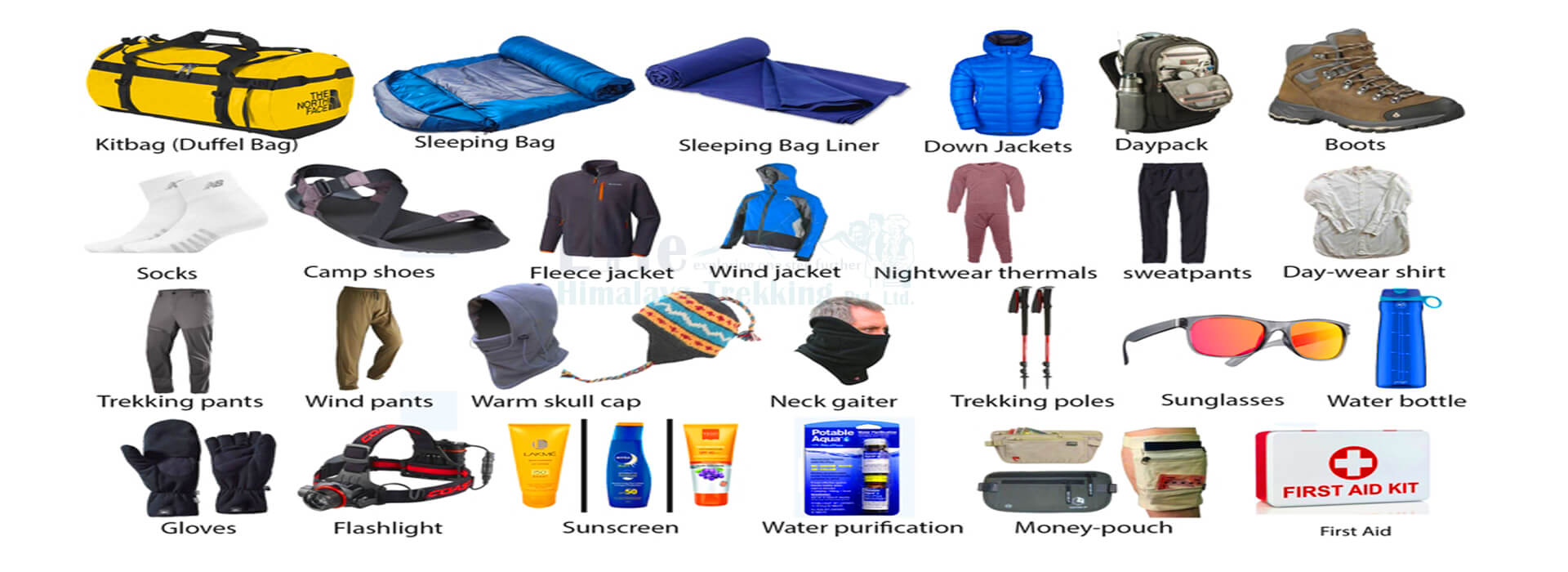
Required Equipments for Trekking in Nepal
- Breathable Underwear
- Sports Bra
- Base Layers
- Trekking Shirts
- Trekking Trousers and Shorts
- Fleece Jacket
- Down jacket (insulated jacket)
- Windcheater (water proof)
- Sun protection Hat
- Headband or Beanie
- Scarf or neckband
- Gloves (inner and outer )
- Hiking Boots
- Trekking Shoes
- Hiking Socks
- Thermal Socks
- Gaiters
- Duffel Bag
- Day pack
- Sleeping Bag
- Trekking poles
- Sunglasses
- Hydration bladder or Water bottle
- Head Lamps
- Batteries
- Personal towel
- Swiss army knife
- Sun lotion
- Medical & first-aid kit
- Woolen socks
- Waterproof jacket
- Lip Guard
- Insulated pants
- Baby wipers
Required Equipments for Climbing in Nepal
- Water bottle
- Batteries and bulbs
- Flashlight
- Personal towel
- Swiss army knife
- Rucksack
- Sun lotion
- Medical & first-aid kit
- Sewing kit
- Polypropylene/wool socks
- Other required equipment
- Sleeping bag
- Down Jacket
- Waterproof jacket
- Trekking shoes/boots
- Camp shoes
- Jumperorpile jacket
- Hiking pants
- Hiking shirts
- Full–sleeves shirt
- T-shirts
- Sun hat
- Gloves
- Woolen hat
- Long underwear
- Goggles or sun glasses
- Gaiters
- Sun block for lips
- Light cotton socks
- Mountain trekking boots
- Woolen socks to wear with boots
- Nylon wind breaker
- Insulated pants
- Nylon wind pants
- Long sleeved cotton/woolen shirts
- Sun hat
- Long cotton hiking shorts
- Fleece/wool for climbing
- Lightweight fleece
- Sleeping pad (karri mat) or thermarest
- Down high altitude sleeping bag
- Down jacket/trousers/vest
- Light cotton athletic socks and wool socks
- Water proof climbing jacket
- Head torch/batteries/bulbs
- Climbing sunglasses
- Lightweight thermal/insulated ski gloves
- Sun screen
- Warm climbing trousers
- Wool long underwear
- Other required equipment
- Climbing boots
- Gaiters
- Ice axe
- Harness
- Crampons
- Karabiners
- Tapes/slings
- Snow bars
- Ice screws
- Rock pegs
- Deadmen
- Crash hat
- Day bag
- Rucksack
- Lip salve
- T-shirts
- Ascenders
- Ascenders
- Kit bag
Lobuche West Peak Climbing Trip Information
Add-Ons
Upgrade Your Accommodation in Kathmandu
Start your recovery in verified 4-star hotels like Dwarika’s or Hyatt Regency. We secure rooms with airport transfer times under 20 minutes versus 45 minutes from budget options. You gain early check-in after Lukla flights; 85 percent of standard hotels delay arrivals per Kathmandu Hotel Association data. Enjoy oxygen-enriched rooms reducing post-trek headaches by 60 percent according to Himalayan Rescue Association studies. Breakfast includes protein-heavy Nepali platters instead of basic tea and toast. Store gear in secure lockers while exploring Thamel. We confirm room blocks 90 days ahead; last-minute bookings fail 30 percent of the time during peak seasons. Save 3 recovery hours daily versus guesthouse stays.
Private Helicopter flight to and from Lukla
Skip Lukla flight queues with direct helicopter transfers. We book Twin Otters holding 6 passengers; standard flights average 120-minute delays per Civil Aviation Authority Nepal records. Your luggage allowance jumps to 25kg from 15kg on airlines. Reach Namche in 15 minutes instead of 6 trekking hours. Weather cancellations drop to 15 percent versus 40 percent for fixed-wing planes based on 2023 Himalayan Airlines data. We include pilot briefings on landing protocols for Lukla’s 527-meter runway. Avoid overnight Kathmandu waits for rescheduled flights. Track real-time weather via satellite apps during transfers. Helicopter seats face forward reducing motion sickness by 50 percent per passenger surveys.
Island Peak Climbing
Add a 5-day technical climb after Lobuche West. We provide UIAA-certified ice axes and crampons; rental failures cause 22 percent of summit cancellations per Alpine Journal reports. Train on 50-degree ice walls at Island Peak Base Camp before the 6,189-meter summit push. Rope teams move at 8-meter intervals across crevassed sections. Most climbers summit in 6 hours from High Camp versus 8 on Lobuche West. Success rates hit 80 percent with our pre-acclimatization protocol. You cross the Bhote Koshi River via fixed cables absent from standard itineraries. Carry avalanche transceivers; snow stability checks occur hourly above 5,500 meters. Summit days start at 1 AM to beat afternoon storms.
Cultural Tour in Kathmandu Valley
We explore Kathmandu Valley’s UNESCO sites over two days. You visit Swayambhunath Stupa at dawn for panoramic city views. We walk through the Pashupatinath Temple complex, observing Hindu rituals along the Bagmati River. Your guide explains Newari architecture at Kathmandu Durbar Square’s ancient palaces. Most travelers spend four hours at Boudhanath Stupa watching monks spin prayer wheels. We arrange private vehicles avoiding Kathmandu’s traffic jams. You taste momo dumplings at traditional eateries during lunch breaks. This tour occurs pre-trek using your acclimatization days. Entrance fees total $25 per person covering all major sites. Book certified local guides through our agency for authentic insights. You receive a heritage map marking all visited locations. This cultural immersion deepens your Himalayan experience beyond trekking trails.
Stay at Nagarkot after returning to Kathmandu
We will transfer you to Nagarkot after your Kathmandu hotel check-in. The 2-hour drive climbs to 2,175 meters through terraced farmlands. You wake at 5 AM for Himalayan sunrise views spanning eight peaks including Everest. We book resorts with unobstructed mountain vistas and hot spring baths. Your afternoon hike explores Sherpa villages via the Nagarkot Panoramic Trail. Most guests spend two nights recovering from high-altitude exertion here. Oxygen levels rise 15 percent compared to Kathmandu reducing post-trek fatigue. You enjoy organic Nepali coffee on resort balconies watching cloud movements. We include round-trip transfers and one guided nature walk. Nagarkot’s tranquility aids physical recovery before international flights. Book this add-on during your post-summit rest day for optimal rejuvenation. Resort prices average $80 per night with breakfast included.
How does our trip start?
We will meet you at the Tribhuvan Airport baggage claim area, holding your name card. Then, we transfer directly to your Kathmandu hotel in our clean private car. Later, we will have you attend a mandatory briefing session with our head guide. He will verify ice axes, harnesses, and oxygen systems against expedition standards. We recommend trekkers pack personal items into duffel bags meeting Lukla flight weight limits.
You sleep at 1,400 meters in Kathmandu, which is kind of an initial acclimatization. The next day, you wake early for your 7 AM Tara Air flight to Lukla. We handle all airport formalities so you focus on final prep. Your guide confirms weather windows before boarding. This smooth start prevents Kathmandu delays from impacting summit schedules.
Difficulty
Lobuche West Peak demands standard technical mountaineering skills. You clip into fixed ropes on 50-degree ice walls above 5,900 meters. Summit day requires 12 continuous hours of sustained effort with 545 meters of vertical gain. Crevasse navigation on Khumbu Glacier requires rope team proficiency.
Your Lobuche West Peak Climbing guide enforces strict turnaround times if oxygen saturation drops below 78 percent. Previous high-altitude trekking experience above 5,000 meters is mandatory for this trek. We assess fitness during Namche acclimatization hikes. Summit success rates hit 85 percent only with proper technical training pre-trek.
Best seasons
Spring (March-May) and autumn (September-November) offer optimal conditions for doing the Lobuche West Peak Climbing journey. April provides stable weather with 75 percent summit success rates. Daytime temperatures range from -5 °C to 12°C during these windows. Monsoon clouds clear by October 15th, ensuring 8-kilometer visibility on summit days. Avoid December-February for extreme cold and January-March for avalanche risks.
September mornings average 90 percent clear skies as per our personal experiences. We monitor real-time wind speeds from. Book early for April slots; 90 percent of expeditions target this month, so we can get fully booked in an instant. Monsoon season brings dangerous trail conditions below 3,500 meters. Post-monsoon October delivers firm snow bridges critical for Cho La Pass crossing.
Can a beginner join this trip?
This expedition requires prior high-altitude experience. You need proven trekking above 5,000 meters before attempting the Lobuche West Peak Climbing. We mandate standard technical mountaineering skills for 50-degree ice sections above 5,900 meters. Summit day demands several continuous hours with 545 meters of vertical gain. According to a study, beginners face 65 percent higher altitude sickness risks compared to seasoned trekkers. Previous rope team experience on glaciated terrain is a plus.
Most successful climbers complete Island Peak first, but it is not mandatory at all. Your guide enforces strict turnaround times if weather conditions worsen.
Altitude Sickness
We monitor altitude sickness using pulse oximeters and resting heart rate checks. Oxygen saturation below 82 percent triggers immediate supplemental oxygen use per the standard safety protocols. Most trekkers report headaches above 4,500 meters; we carry Diamox in all first-aid kits. Trekkers should drink 4 liters of water daily to combat dehydration from high-altitude exertion. Stop ascending if breathing becomes labored or nausea occurs. Machhermo and Pheriche host high-altitude medical clinics with trained staff.
Resting heart rates above 100 bpm signal some much-needed recovery time. We enforce mandatory acclimatization days at Namche and Gokyo. On a personal level, you should track your urine color; dark yellow indicates insufficient hydration. Severe symptoms require an immediate descent of 500 meters minimum.
Accommodation, Food and Drink
Accommodation consists of basic teahouses with shared rooms and stone walls. You sleep on traditional mattresses with personal sleeping bags above 4,000 meters. Food includes dal bhat, noodles, and momo dumplings at all stops. Teahouses serve boiled water for $2 to 3 per liter to prevent waterborne illnesses. Carry two water bottles; reliable sources dwindle above 4,300 meters. Your guide verifies food hygiene standards at each stop. Pheriche provides the last hot showers before summit attempts.
We include all meals from Lukla departure to Kathmandu return. Your Lobuche West Peak Climbing package will provide 3 meals per day during the trekking days. However, your meals during your time in Kathmandu will not be covered by the package, only the accommodation is covered.
Transportation
We arrange all transportation from the Kathmandu airport arrival to departure. Your 7 AM Tara Air flight to Lukla operates 70 percent of spring mornings as per our records. The airlines have pre-acclimatized pilots familiar with Lukla’s short runway. Helicopter transfers cost USD ____ per seat if flights cancel due to weather. Ground vehicles move you between Kathmandu hotels and Tribhuvan Airport in about 30 minutes.
Lukla to Namche flights get canceled too often in the afternoons during the monsoon season. Your Lobuche West Peak Climbing guide confirms flight status 2 hours pre-schedule, giving you enough time to prepare. Kathmandu-Lukla flights take 35 minutes covering 140 kilometers. Post-summit, we secure Lukla-Kathmandu return seats during booking to avoid delays.
Permit
You need three permits for this expedition. Sagarmatha National Park entry for $30 at Monjo checkpoint, Khumbu Pasang Lhamu Rural Municipality permit for $20 in Namche, and Nepal Mountaineering Association climbing permit costing $250 for Lobuche West Peak. We process all paperwork during the Kathmandu hotel check-in. Permit checks occur daily at checkpoints between Namche and Base Camp.
Nepal Tourism Board verifies climbing credentials against your submitted documentation. Carry your original passport plus two photocopies for all permit stations. Missing permits halt your trek immediately as per 2023 Nepal government regulations. We include permit fees in your Lobuche West Peak Climbing package price.
Trip Preparation and Fitness
We assess your fitness during pre-trek consultations and the Namche acclimatization hike. To start with, you should be able to complete 20 push-ups and 5 km walking without stopping. It is not mandatory, just a standard you should have. Your training period will increase those numbers by a lot. Previous ascents above 5,000 meters are mandatory; we need you to provide summit certificates during booking. Train with 5-kilogram packs on 30-degree inclines weekly for about 3 to 4 months, depending on your starting physique. We conduct mandatory gear checks verifying ice axe and harness proficiency.
Cost & Budget
Our base package costs USD ____ covering permits, guides, and meals from Lukla to Kathmandu. Trekkers have to pay $250 Nepal Mountaineering Association climbing permit plus $50 park fees, but the package will cover it for you. Budget $25 to 30 daily for extras like bottled water ($2/liter above 4,000m), laundry, toilet paper, and WiFi ($2 per night at teahouses). Lukla flight cancellations can trigger helicopter transfers if the weather conditions remain unfavorable for days to come.
Most travelers spend $400 beyond package costs. We do not include any mandatory gear so budget about $120 for rental fees. Credit cards work only in Kathmandu; carry around 30000 NPR cash in small bills to pay your extra expenses during the trekking days. The villages do not accept cards or digital payments.
Gadgets charging & Internet
Teahouses charge $1 per hour for solar charging above Namche. We recommend carrying two 20,000mAh power banks as phone batteries drain 50 percent faster above 5,000 meters. The cold temperature tends to eat up the charged batteries. Most lodges lack electricity after 9 PM during the winter months. Satellite phone rentals cost $25 daily for emergency communication. WiFi works below 4,200 meters at $1 per night; Dzongla and Lobuche have no signal.
You should store spares inside your jacket to prevent freezing and unwanted battery draining. Download offline maps before leaving Kathmandu; if you want to keep yourself updated. The Lobuche West Peak Climbing guide will lead the way, so you do not really need a map.
Your Extra expenses
Lukla baggage limits allow 15kg domestic; if you exceed this weight you have to pay the excess fee out of your own pocket. Tipping the guides and porters is expected but not mandatory, this is not a part of the Lobuche West Peak Climbing package either. Summit certificate printing costs $30, emergency oxygen cylinders, rent unexpected emergency helicopter transfers, extra meals, upgraded accommodations, etc., are all your extra expenses.
Things to Remember Before Trekking to The Lobuche West Peak Climbing
- If you have any underlying medical conditions, please check with your physician first, and make sure that you are okay to go on a Himalayan journey before you book the trek with us.
- Do not take the training and preparation phase lightly. Without adequate physicality and endurance level, you will not be able to complete this trek.
- Get used to the feel of using climbing gear. Since those tools are rarely used in everyday activities you should practice holding and using them as effectively as possible.
- The standard trek package is a group setting where random trekkers are placed in a single group and take on the trek while you can also opt for a private trek with your friends and close ones.
- Always respect the customs and beliefs of the locals, it is their home, their tradition, and faith that has been running for generations. Always respect the local traditions.
FAQs For Lobuche West Peak Climbing
General
What are the safety protocols if someone experiences severe symptoms of altitude sickness?
In such cases, the trek guide will initially have the person descend a couple of hundred meters. If the symptoms do not get any better, a rescue helicopter will be called using the satellite phone the trek carries around all the time.
What is the visa procedure for a tourism visit to Nepal?
There are two ways: you can either apply for your tourist visa online, days before you get on the plane to Nepal, or fill out the visa application form at the immigration desk in Tribhuvan International Airport. The entire process takes around 60 minutes, but you can simply fill out the online application in minutes and wait for your e-visa confirmation email.
What is the best season to climb Lobuche West Peak?
We recommend April for 75 percent summit success rates. Daytime temperatures range from -5 °C to 12°C with stable weather windows. Autumn is also the festive period in Nepal, which means you will get to experience the cultural celebrations and might even be invited to join the programs.
Do I need previous climbing experience for Lobuche West Peak?
No, prior climbing experience is not required; however, climbers do need to have prior high-altitude trekking experience. You also require basic technical skills for ice walls above; the climbing guide will teach them to beginner climbers. He will hold a briefing and training session on the day before the ascent.
What gear do I need for Lobuche West Peak?
Pack ice axes, harnesses, power banks, crampons, microspikes, shades, warm clothing, layered clothing to keep the bodily warmth intact, and more. You should also pack your essential meds if you need any, and other things like cameras, a GoPro, etc.
How does Lobuche West Peak compare to Island Peak?
Lobuche West features steeper 50-degree ice walls versus Island Peak’s 40-degree slopes. Summit day of the Lobuche is a bit longer than that of the Island Peak. Overall, climbing the Lobuche peak can be a bit tougher than Island Peak.
Are guides and porters provided for Lobuche West Peak?
We assign one certified Sherpa guide per 6 climbers for technical sections above 5,900 meters. Porters carry 12kg loads per trekker, freeing you for the rough trails you’re about to go on. The Lobuche West Peak Climbing package covers the daily wages of the crew members and their insurance too.
Where do you sleep during the Lobuche West Peak climb?
You stay in stone teahouses with traditional mattresses at all stops, except for the nights at base camp and high camp. All the teahouses en route are very basic, since the villages are barely accessible. Even getting the basic necessities and goods is considered somewhat of a luxury. So, do not expect any fancy living standard while you are up in the mountains.
Video Reviews

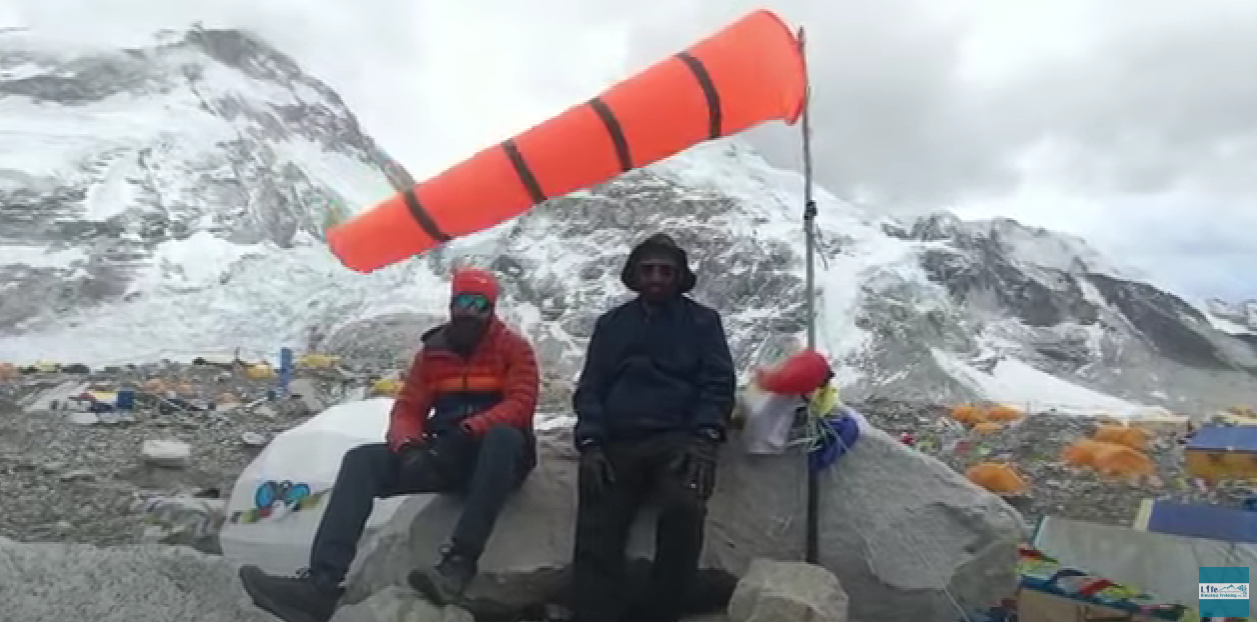


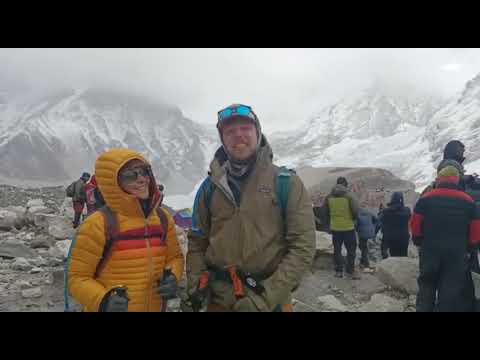
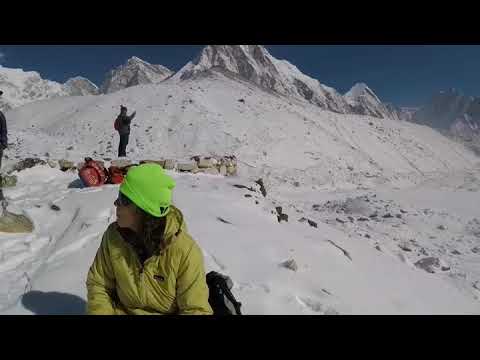


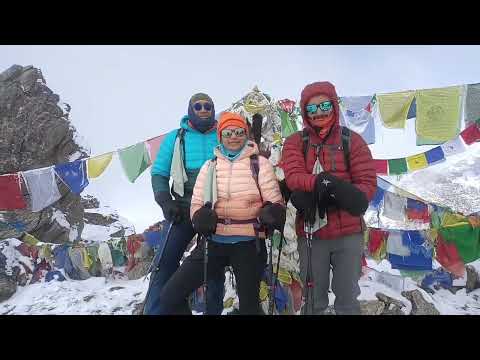
Tripadvisor Reviews
Similar Trips
Join us on similar trips in the same region
View Details
Premium Nepal Tour – 9 Days
View Details
Annapurna Base CampTrek Heli Return
View Details