
 English
 Dutch
Dutch Japanese
 Hindi
Hindi Italian
 Spanish
 French
 German
 Chinese
 Korean
 Arabic
 Hebrew
 Russian
 Portuguese
 Danish
 Czech
Czech Polish
 Swedish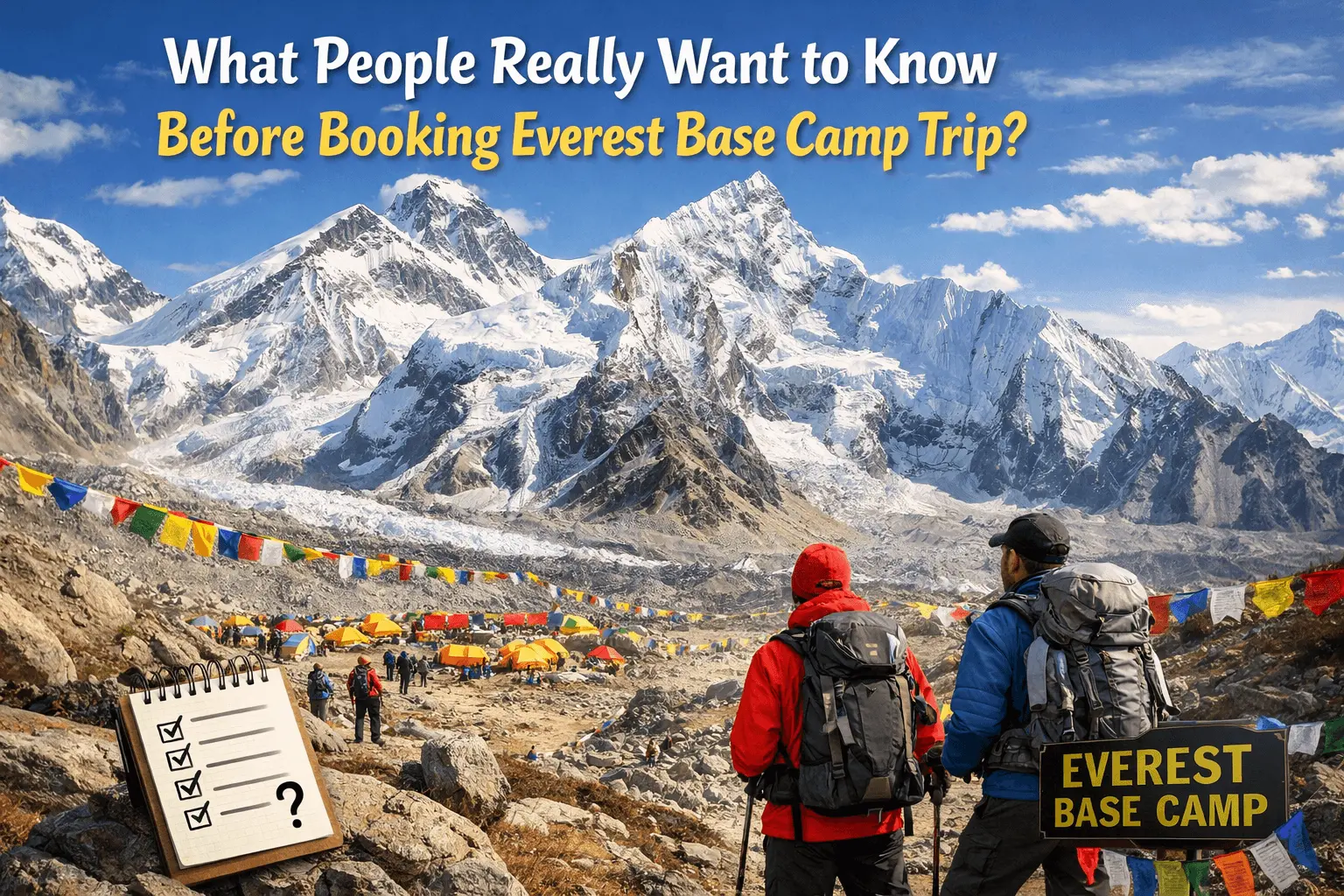
What People Really Want to Know Before Booking the Everest Base Camp Trip?
Booking something related to Mount Everest was never part of a simple plan. At some point, the thought just appeared unexpectedly. It came from a deeper place. The moment the idea enters your mind, a quiet storm of thoughts begins. Excitement mixes with doubt. Curiosity fights with fear. One moment you feel brave, the next you wonder if you’re being unrealistic. So, you start to dig, What People Really Want to Know Before Booking the Everest Base Camp Trip?
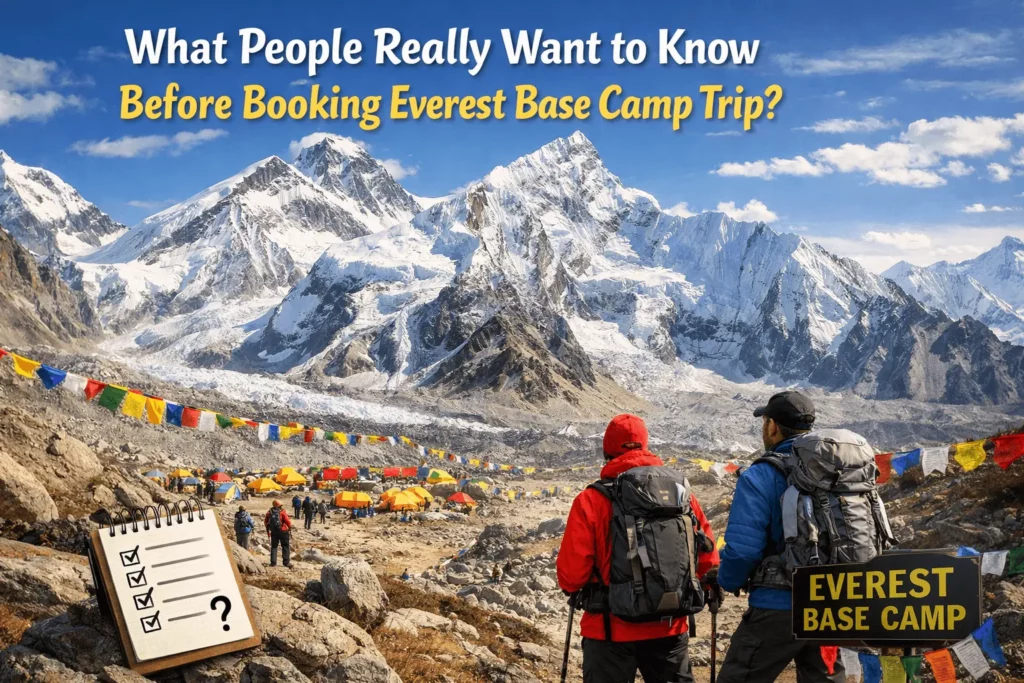
Questions start coming fast.
Am I fit enough?
Can I really walk for days at high altitude?
What if I get sick?
What if I don’t make it?
What People Really Want to Know Before Booking the Everest Base Camp Trip?
People who book journeys toward Mount Everest often describe it as an emotional rollercoaster. There’s excitement when you imagine standing in the Himalayas. Nervousness when you think about altitude and cold. Pride when you realize you’re actually considering something meaningful. And beneath it all, a quiet voice saying, “If not now, when?”
In this blog, you’ll find answers to every question that crosses your mind during this process. Whether it’s fitness, fear, preparation, or simply understanding what this journey really demands, everything that follows is meant to guide you through those second, third, and fourth thoughts—until uncertainty slowly turns into clarity.
Understanding What Mount Everest Really Is
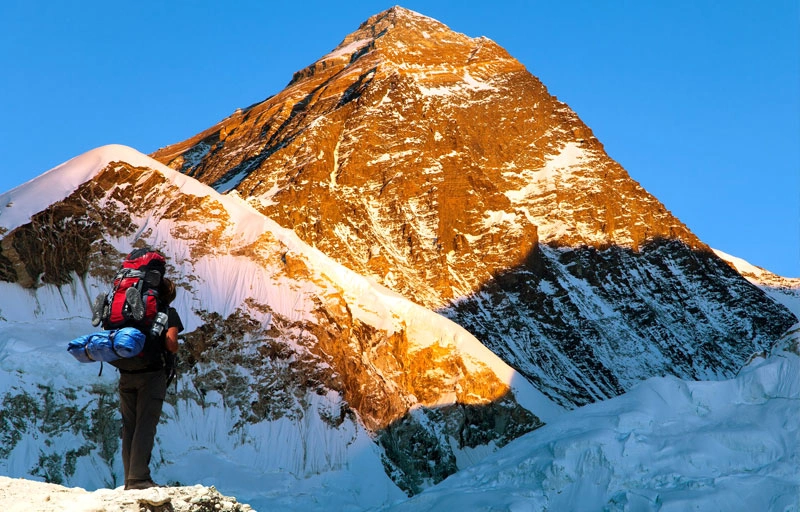
Before considering any journey associated with Mount Everest, it is essential to understand the mountain beyond popular headlines and simplified descriptions. Mount Everest, standing at 8,848.86 meters (29,031.7 feet) above sea level, is the highest point on Earth and is located in the Himalayan range, along the border between Nepal and the Tibet Autonomous Region of China. On the Nepali side, it is known as Sagarmatha, while in Tibetan it is called Chomolungma, reflecting its cultural and spiritual significance long before it became a global symbol of mountaineering.
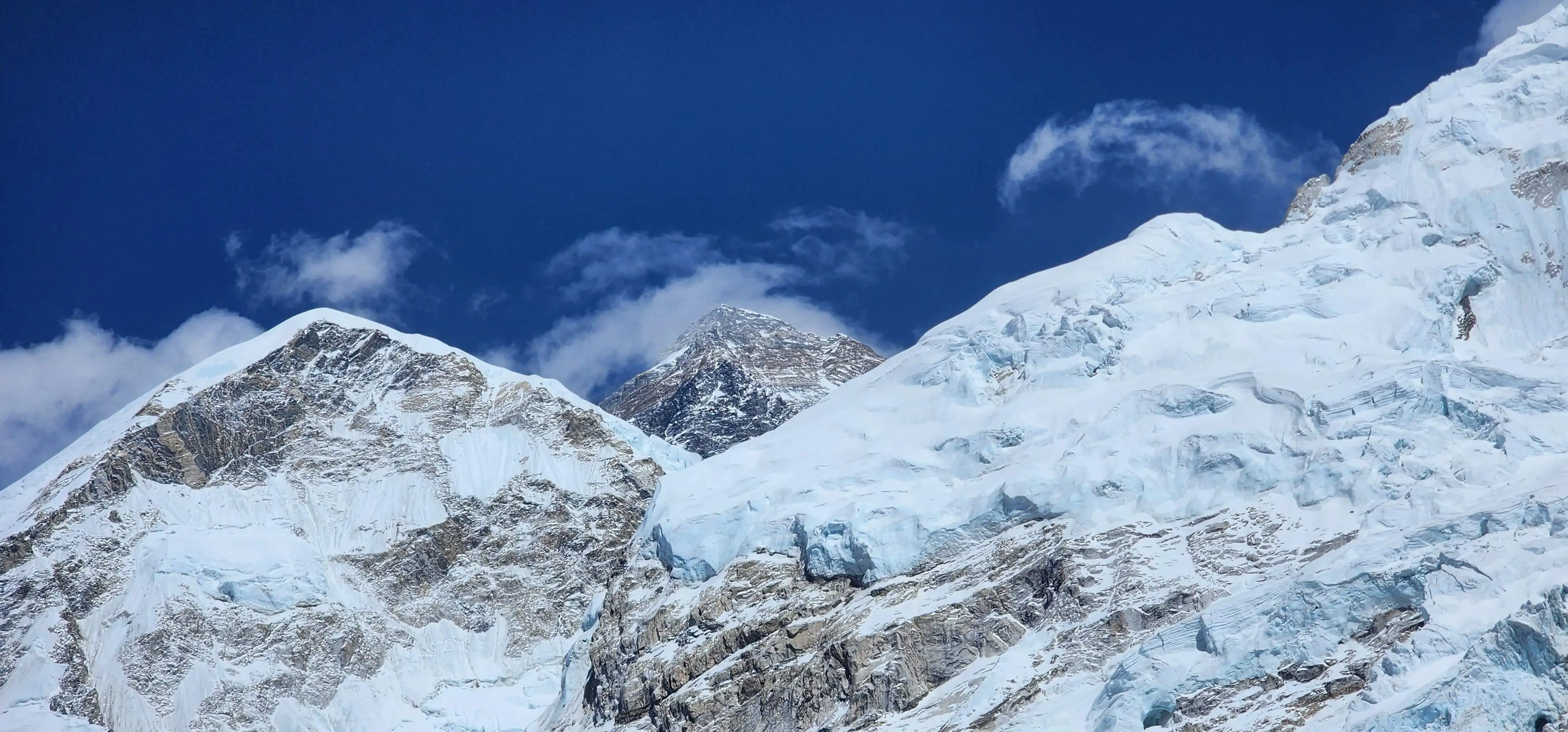
The environment of Mount Everest is defined by extreme natural conditions. At such elevations, oxygen levels are significantly reduced, with the summit containing only about one-third of the oxygen available at sea level. This physiological reality affects all human activity, making even basic movements physically demanding. Above certain altitudes, the human body cannot fully adapt, which is why careful acclimatization and pacing are fundamental to any activity in the region.
Weather patterns around Everest are highly unpredictable. Strong winds, sudden temperature drops, snowfall, and storms can occur without warning, even during the most stable climbing seasons. Temperatures near the summit can fall well below –30°C, and wind chill can make conditions even more severe. These factors mean that progress on Everest is governed entirely by environmental conditions rather than personal ambition or physical strength alone.
Geologically, Everest is part of an active mountain system formed by the collision of the Indian and Eurasian tectonic plates, a process that continues today. This ongoing geological activity contributes to unstable terrain, glaciers, icefalls, and rock movement, particularly in areas such as the Khumbu Icefall, which is considered one of the most hazardous sections of the mountain.
Mount Everest is not solely a physical challenge; it is an environment that requires constant assessment, decision-making, and restraint. Success in this region depends on understanding risk, respecting limitations, and adapting to conditions rather than attempting to dominate them. As a result, Mount Everest is widely regarded not merely as a destination, but as a complex and demanding natural system where preparation, experience, and environmental awareness are critical.
For many people, learning this brings clarity. Everest is not about conquering something external. It’s about learning how to move carefully within something much bigger than yourself. This realization often eases the pressure. You don’t have to be extraordinary—you just have to be prepared and respectful.
Fitness, Readiness, and the Reality of Preparation
One of the first practical concerns when planning a journey toward Mount Everest is physical readiness. This is not about extreme fitness or athletic performance, but about whether the body can function well at high altitude over multiple days. The Everest Base Camp trek is designed to support gradual adaptation, with a slow pace and planned acclimatization days that allow the body to adjust to lower oxygen levels. Most people who prepare through regular walking, basic endurance training, and consistent physical activity find the trek manageable. Proper preparation focuses on steady conditioning and awareness rather than speed or strength.
Equally important to physical readiness is the role of experienced guides. Once a trek is booked, professional guides—most of whom are Sherpas from the Himalayan region—support trekkers from the beginning of the journey until the return. These guides manage pacing, monitor acclimatization, and make decisions based on weather and individual conditions. It is essential to listen carefully to your guide at all times. Sherpa guides have walked these trails many times, understand how the body reacts to altitude, and can recognize risks before they become serious. Their experience is a critical part of staying safe, and following their guidance ensures a well-managed and responsible journey in the Everest region.
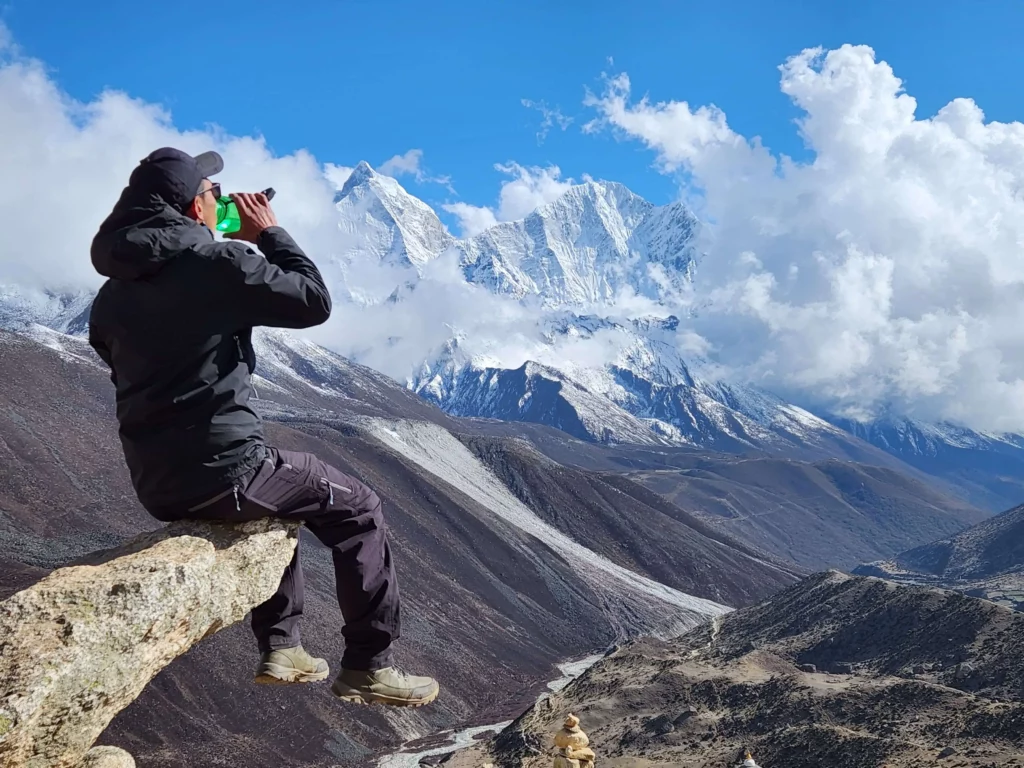
Often, the fear isn’t physical at all. It’s mental. And once the journey begins, that fear slowly transforms into confidence.
The Question of Altitude and Safety
Safety is never guaranteed, even at home. Unexpected situations can arise anywhere, and what truly matters is how well those situations are understood and managed. In the Everest region, safety is not about eliminating risk completely, but about recognizing conditions early and responding correctly. Altitude is often the greatest unknown for people thinking about Everest, largely because thin air sounds intimidating. However, altitude itself is not an enemy—it is an environmental condition that requires patience, awareness, and proper handling.
When movement is slow, hydration is consistent, and the body is given enough time to adapt, altitude becomes manageable for most trekkers. This is where experience and guidance play a critical role. Local Sherpa guides understand the rhythm of the mountains through repeated exposure and long-term experience. They are trained to recognize early signs of altitude-related issues and to decide when to continue, rest, or adjust plans. With proper acclimatization and professional guidance, most people experience temporary discomfort rather than serious risk. Understanding this replaces uncertainty with structure and allows safety to be managed through preparation, pacing, and informed decision-making.
The Cost of an Everest Base Camp Journey
Everest sounds big, intense, and unreachable, so it often surprises people to learn that getting to Everest Base Camp is actually more affordable than they imagined. The final cost mostly depends on when you go, how long you trek, and the level of comfort and support you choose along the way.
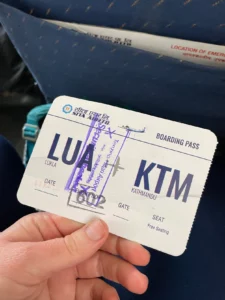
A standard guided trek usually covers the essentials—flights to Lukla, teahouse stays, meals during the trek, experienced local guides, porters, permits, and overall logistics. Costs increase if you add things like private guides, upgraded lodges, or a helicopter return. In the end, it’s less about finding the cheapest option and more about choosing a well-organized trek that values safety, proper acclimatization, comfort, luxury, and experience/seasoned trekking professionals providing local support, so you can focus fully on the journey without unnecessary stress.
Life, Culture, and Meaning Beneath Everest
Mount Everest does not exist in isolation. Beneath it lies a living world shaped by centuries of adaptation. Sherpa culture is deeply woven into the landscape. Their relationship with the mountain is spiritual, not competitive. Everest is not something to conquer—it is something to coexist with. Understanding this changes the way people experience the trek. You stop seeing Everest as a trophy and start seeing it as a teacher. Every monastery, every village, every shared cup of tea carries quiet lessons about resilience, humility, and balance.
Permits, Regulations, and Responsible Travel
Trekking in the Everest region requires specific permits, including national park and local area permits. These are arranged by trekking agencies or guides and contribute directly to conservation, trail maintenance, and local communities. Following established routes and regulations is an essential part of responsible travel in this region.
Equally important is respecting local culture, traditions, and environmental guidelines. Simple actions—such as minimizing waste, respecting religious sites, and listening to local advice—help preserve the region for future generations. Responsible trekking ensures that Everest remains not only accessible, but protected.
The Emotional Weight of the Journey
As practical concerns begin to settle, another layer appears, which is the emotional one. People often don’t expect how deeply personal this journey becomes. Walking for days through quiet valleys gives space for reflection. Thoughts surface that were previously drowned out by daily life.
Everest has a way of stripping things down. There’s less distraction. Less noise. Less pretending. What remains is honest effort and presence. For many, this is where the journey truly begins—not at Base Camp, but somewhere between villages, beneath fluttering prayer flags, where life suddenly feels simpler and clearer.
Standing Before the Mountain
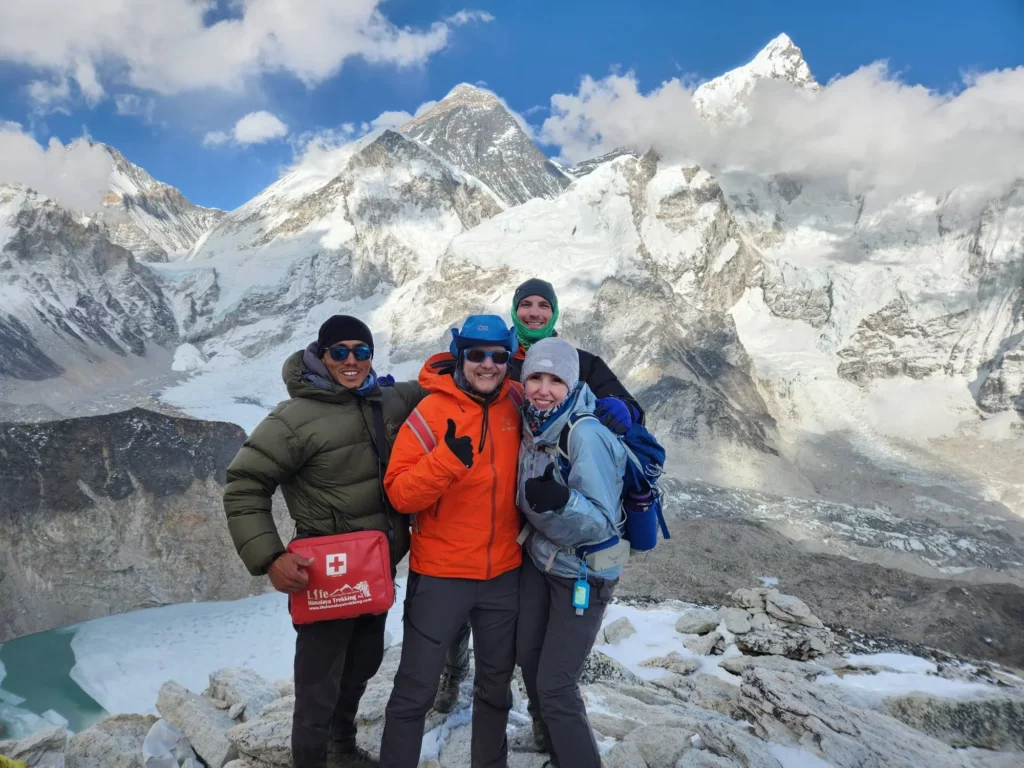
Standing at Everest Base Camp doesn’t feel dramatic in the way people imagine. There is no big sign, no celebration, no applause. Just rocks, ice, prayer flags, and silence. And yet, it’s deeply emotional. You think about how far you’ve walked. The cold mornings. The tired legs. The quiet determination it took to keep going. Suddenly, everyday worries feel smaller, lighter, less important. Many people don’t cry or shout. They simply stand still, take a deep breath, and smile.
Why People Still Choose Everest
People don’t choose Everest because they feel like they can do it. They choose it because it offers something rare in a fast-moving world: clarity. The clarity that comes from effort. From silence. From walking one step at a time toward something meaningful. Everest doesn’t promise transformation. But those who approach it with honesty often return changed—not louder, not prouder, but steadier and more aware of what truly matters.
Should You Book the Everest Base Camp Trek Now?
If you’ve been thinking about this journey for years, waiting for the “perfect time,” here’s a quiet truth worth hearing: there is no perfect time. There is only the moment you decide to go. Booking the Everest Base Camp trek isn’t about proving anything to anyone else. It’s about doing something meaningful for yourself. Something that challenges you, grounds you, and reminds you what it feels like to be fully alive. The mountains will still be there tomorrow.
But the version of you who wants this experience—that moment deserves attention now.
Find your perfect Everest Trekking Package and Everest Helicopter Trekking Packages
Where to Book?
The quality of the experience often depends less on the trail itself and more on the people who organize and guide the journey. Booking through a local trekking company with deep roots in the Everest region makes a meaningful difference. Such companies understand the terrain, weather patterns, altitude challenges, and local culture far better than operators working remotely. More importantly, they rely on experienced Sherpa guides who have spent much of their lives in the Himalayas and have walked these routes many times.
Life Himalaya Trekking is one such company that has been working in the Everest region for many years. We specialize in Everest Base Camp treks and high-altitude journeys, operating with a team of experienced local guides. From the moment the trek begins until you return to where you started, the guides remain responsible for pacing, acclimatization, safety decisions, and overall coordination.
Flights, permits, accommodations, and daily planning are handled professionally, reducing uncertainty and stress. When guides have real experience in the region, trekkers benefit from knowledge that cannot be learned from books or maps alone. In a place like Everest, this kind of local understanding is not optional—it is essential.
Plan your trip now
Final Reflection
Thinking about booking a journey to Mount Everest is not just a sign of adventure seeking. It’s often a sign that something inside you is searching for depth, challenge, and truth. The doubts, the questions, the hesitation—they are all part of the process. Everest doesn’t demand perfection. It demands respect. Finally, when you meet it on those terms, it quietly gives you answers you didn’t even know you were looking for. These are the things – What People Really Want to Know Before Booking the Everest Base Camp Trip?