
 English
 Dutch
Dutch Japanese
 Hindi
Hindi Italian
 Spanish
 French
 German
 Chinese
 Korean
 Arabic
 Hebrew
 Russian
 Portuguese
 Danish
 Czech
Czech Polish
 Swedish
Everest Base Camp: An Adventure Beyond Your Wildest Dreams
Who wouldn’t be excited by the thought of arriving at the mountain’s base camp? Visiting Everest Base Camp is undoubtedly on everyone’s bucket list of things to do (EBC). One of the most well-known and recognized treks in the world is the EBC trekking. The wildest dream of every fan of trekking has been EBC in particular.
Introduction to the Everest Base Camp Trek
Mount Everest is situated on the border between Nepal and China in the eastern part of the country. The main approaches to Mount Everest are from the southeast and northeast. North Base Camp is in Tibet, whilst South Base Camp is in Nepal. Climbing Everest is a really challenging task that hardly everyone can accomplish in their lifetime. The good news is that you may still feel its presence if you undertake the difficult trip to the magnificent peak’s base camp. While Everest soars to an incredible 8,848 m (29,029 ft) in height, EBC stands at a height of 5,364 m. (18,193 ft).
The Everest region is well-protected by the Sagarmatha National Park, a UNESCO World Heritage Site. Making the ascent to Everest Base Camp will provide you the chance to experience nature, culture, customs, flora, and fauna all at once. Without a doubt, the adventure will be thrilling and full of novel encounters.
There are several EBC trekking packages available, and they vary somewhat from one another in terms of the trek’s itinerary, duration, additional add-on treks, and whether a helicopter journey is included. The 7-Days Everest Base Camp Trek is the best package. This article mainly focuses on regular EBC Trekking.
You can also check Helicopter Trek To Everest.
Table of Contents
Recognizing the Beauty and Adventure of the Trek
Panoramic Mountain Views on EBC Trekking
Although it may sound cliché, the mountains and breathtaking panoramas of the area are one of the finest aspects of the EBC trekking. You will see four of the top ten highest peaks up close during this trek, namely Mt. Everest (8848.86m), Mt Lhotse (8516m), Mt. Makalu (8485m), and Mt. Cho Oyu (8188m). Additionally, you will be able to see over 15 other mountains, which is magnificent in and of itself. You will feel boundless peaceful walking among these massive mountains and hills.
As the gorgeous mountains appear one by one in front of you, you’ll find yourself slowing down and unwinding. What’s impressive is how distinctive the hills are on their own. For example, while one is photogenic, another is revered, and the next is deadly. While you’ll see all these peaks personally when you are on the EBC trekking, I’ll tell you about a few.
Mt. Everest
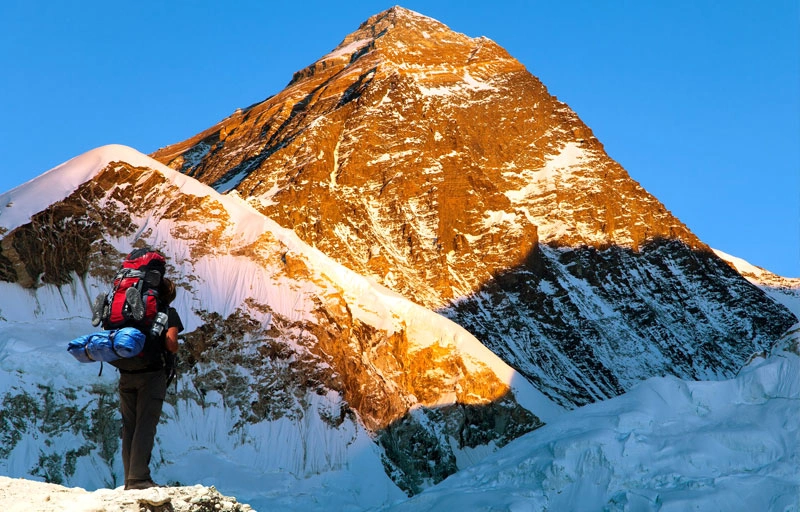
The world’s highest peak needs no introduction. Everest is a brand in itself.
Lhotse
At 8516 m in height, the fourth-highest mountain peak in the world is Lhotse. One of the Himalayas’ most breathtaking sights is on this mountain’s southern slope. Lhotse has occasionally been incorrectly identified as the south summit of the Everest massif. In 1956, a Swiss team made the first ascent to Lhotse. Lhotse consists of three summits: Lhotse Main (8516 meters), Lhotse Shar (8383 meters), and Lhotse Middle or East (8413 meters). It is Lhotse I or Lhotse Main that is the world’s fourth tallest peak.
Cho Oyu
Cho Oyu translates as “Turquoise Goddess” in the Tibetan language. This world’s sixth-highest mountain is reputed to be the easiest mountain to climb among the eight-thousanders. An Austrian team made the first ascent in the year 1954 AD.
Khumbila
The Khumbu region’s protector deity and the holiest peak is Khumbila, which rises to a height of 5761 meters—according to a widely believed legend, Guru Padmasambhava, an important historical figure in Buddhism, spent three days in solitude meditation on the mountain’s southern slopes. Climbing is strictly prohibited because people revere this mountain.
Ama Dablam
Ama Dablam means ‘Mother’s Necklace’ in the Sherpa language. The mountain was given this name because its ridges resemble a mother holding her baby, and its glacier’s curve resembles a necklace. One of the most stunning mountains in the world is AMA Dablam! It is popular among photographers since it has some of the Himalayas’ most picturesque scenery. The participants in a research trip headed by Sir Edmund Hillary made the first ascent to Ama Dablam in 1961 AD.
Diverse Flora and Fauna
Regarding the vegetation encountered during the EBC trekking, it varies depending on the elevation. The trail from Lukla to Namche lies in the lower area, dominated by rhododendron and blue pine trees. Silver Fir replaces them as we ascend from Namche. After that, you can notice that the Himalayan Birch predominates in the Tengboche area. Dwarf rhododendrons and dwarf junipers take center stage as we move upper. Ultimately, the highest region features an almost bleak landscape.
The fauna in the Everest region is famous for being less aggressive than that seen along other well-traveled routes like the Dhaulagiri Circuit and the Annapurna Circuit. One can view a wide diversity of wildlife in Sagarmatha National Park. The national park serves as a habitat for 118 different bird species. There are frequent sightings of Himalayan Tahr, Musk Deer, Common Leopard, Himalayan Monal, Blood Pheasant, and Himalayan Griffon. You are lucky if you get to witness rare species such as the Snow leopard, Red Panda, Golden Eagle, etc.
Embracing the Thrills and Challenges of the Trek
The tough journey from Kathmandu to Kala Patthar and Everest Base Camp will take you from 1,350 m (4,429 ft) to 5,545 m (18,193 ft) in height. The significant increase in altitude is a great adventure and challenge in and of itself. But the joy and excitement you will experience make EBC trekking worthwhile. The trek gives you the chance to see Nepal’s diverse topography and its huge variety of flora and animals, providing you with lifelong memories.
The trail’s lower section (up to Dingboche) mostly passes through luxuriant fir, pine, rhododendron, juniper forests, etc. There are forests all over the hills with stunning waterfalls and wonderful streams. You leave the forests behind as you proceed through Dingboche village and stroll alongside shrubs and terraced fields instead. You can see the shift in the terrain and feel the air pressure because the elevation has risen above 4,000 meters. Rocks and boulders quickly appear along the path. You stroll along the lateral moraine of the Khumbu glacier while passing by gorges. The upper region of the trail passes through gorges and frozen streams.
Additionally, the brotherhood you’ll feel with the fellow trekkers you meet will make this challenging trek endurable and worth it.
Navigating the Trails and Terrain to Everest Base Camp
Lukla to Phakding
After reaching Lukla, the actual trekking journey begins. You will pass through spectacular landscapes and mountains like Karyolung, Nupla, and Gongla during the hike from Lukla to Phakding. You’ll observe Tibetan prayer flags flapping in the wind and locals reciting Tibetan mantras as you travel along the route. After a gradual descent, you will reach Phakding, a small village on the Dudh Koshi River’s bank.
Phakding to Namche
The following day’s excursion will take you across a lush wonderland of cool, shaded trees, elusive waterfalls, and picturesque suspension bridges across the raging Dudh Koshi River. You will reach Namche Bazaar, the most popular stopover for trekkers and climbers in the Khumbu region, after navigating a series of suspension bridges.
Acclimatization in Namche
The next day is spent acclimatizing in Namche. You’ll trek today to close locations like the Hillary School, Hotel Everest View, or Sherpa Culture Museum before returning to Namche Bazaar. Here, you can get close-up views of Mt. Ama Dablam. Ama Dablam is popular for its aesthetic appeal and photographic potential.
Namche to Tengboche
Your trek to Tengboche will begin the following day via a narrow trail. You will pause frequently to see the breathtaking views of the summits Ama Dablam, Everest, Tabuchi, Thamserku, and many others. When you finally reach Tengboche village, you will have traveled through a rhododendron forest. Tengboche is a hilltop village which is known for Tengboche Monastery, the largest monastery in the Khumbu region.
Tengboche to Dingboche
On the sixth day, we will travel to Dingboche. On the way to Dingboche, you pass through a dense rhododendron forest before crossing many lengthy suspension bridges over the glistening Imja River, all the while taking in the view of the enormous, white mountains like Lhotse and Ama Dablam that tower over the horizon. Along the trailside, you can see many stones set. Keep them to your right at all times as you move past them. After traversing vast terrace fields of potatoes and barley, you eventually arrive at Dingboche and spend the night there.
Acclimatization in Dingboche
In Dingboche, it’s time to acclimatize once more. You will carefully ascent to the viewpoints of Chukhung Village or Nagarjun Hill on this day of rest. The views of Lhotse, Makalu, Ama Dablam, and several other peaks are superb from both of these vantage locations. After that, you’ll head back to Dingboche to stay for the night.
Dingboche to Lobuche
On the eighth day, we trek to Lobuche. The trail begins with a brief ascent before entering grassland. You will now cross the suspension bridge to Thukla and go up steep terrain until you reach the Lobuche Pass. Numerous vibrant prayer flags, a chorten, and a cemetery with numerous cairn memorials to those who perished on the mountain can be spotted here.
Lobuche to Gorakshep and EBC
Your surroundings the following day will include views of the enormous Khumbu glacier and mountains as you stroll over wide trails. Once at Gorakshep, you proceed to the iconic Everest base camp. You will feel a wave of emotions as you are at the base camp of the tallest peak in the world. You will spend around 30 minutes taking it all in before returning to Gorakshep, where you will spend the rest of the night.
Climb Up to Kala Patthar and Trek to Pheriche
The next day is another crucial day of this expedition. You’ll climb up to Kala Patthar. The closest view of Everest that you can get without scaling the mountain is from this vantage. Additionally, it provides a 360-degree vista of several legendary peaks, including Thamserku, Nuptse, and Ama Dablam. After enjoying the mountains there for as long as you like, we make the walk down to Gorakshep and descend to Pheriche. Beautiful hills and mountains surround the valley of Pheriche.
Pheriche to Phortse
For the next day’s trek, you can take a less congested route which will lead you to Phortse village. Additionally, you will get to see Ama Dablam, Thamserku, and the Tengboche Monastery from a different perspective. This trail, which is primarily downhill, travels through the stunning Pangboche village and the stunning landscapes of the Khumbu region.
Phortse to Monjo
You will savor every second of the adventure as it comes to a finish. You will calmly go from Phortse through the lovely Namche Bazaar and down to Hilary Bridge before reaching Monjo village.
Monjo to Lukla
The next morning, you will walk through the same route when ascending for the Short Everest Trek. This is your last day trekking-wise. Before the EBC trekking journey comes to a close in Lukla, you will transverse through the same villages, including Phakding, Ghat, and Cheeplung. You will celebrate the accomplishment of the expedition there that night.
Lukla to Kathmandu by Flight
Though the trek has ended trekking-wise, the EBC trekking is not officially over. You’ll take a flight from Lukla to Kathmandu the following day. If you want to, you can stay in Kathmandu for one or a few extra days. The trek is complete once you leave for your final destination from Kathmandu.
Exploring the Culture and People of Nepal
The simplicity of the natives’ way of life along with their unmatched culture and priceless experiences add to the magnificence of the EBC Trekking. The Sherpas dominate the Khumbu region. One of the strongest and fiercest ethnic groups in the Himalayas is the Sherpa. Sherpas are renowned for their kindness and benevolence in addition to their tenacity and expertise in high-altitude climbing. More than just guides, they are also known for their cheeky sense of humor and ability to make friends with Westerners.
Buddhism is widely practiced in the Khumbu region since it is so close to the Tibetan border. There are numerous Buddhist monasteries to explore in this region. These artistic monasteries carry the distinctive history and traditions of the Sherpa people. Tengboche Monastery is the most well-known of them all.
Mani Rimdu Festival provides an excellent opportunity to learn about and experience Sherpa and Tibetan culture. It is a long-standing ceremony that celebrates Buddhism’s victory against Bon. Monks will dress up in a variety of terrifying masks and costumes for the occasion. In addition, they perform various dancing styles while demonstrating how Buddhism defeated Bon. Khumbu also celebrates other festivals like Gyalpo Lhosar, Tiji Festival, and Dumji Festival.
Reaching the Summit of Everest Base Camp
Reaching base camp (the ultimate destination of the trek) leaves you with an unfathomable sense of pride and accomplishment that is impossible to describe. The enormity of the moment will make the effort worthwhile when you stand in Mount Everest’s shadow. The sense of accomplishment and the beautiful views after your strenuous climb will raise your spirits.
Celebrating the Accomplishment and Reflecting on the Journey
You’ll come to understand by the end of this trek that the triumph extends beyond simply getting to Everest Base Camp. It’s filled with events and stories you’ll remember for the rest of your life.
When you look back on the journey, you’ll realize having a distinct goal that is backed by a thought-out plan gives you the focus to exhibit your best behaviors and performance. Experiencing the harsh realities of living in a developing nation and being exposed to the magnificence of nature will humble you to the core. You will discover that progressing requires breaking down a difficulty into “the next most crucial step” while you are struggling and being tested, whether it be physically or mentally. You will be in awe of what you saw and felt on the EBC Trekking for the rest of your life.
Encouraging Others to Pursue Their Adventure Dreams
Going on an adventure gives your life newness. You gain a zest for life from the joy you feel while on your adventure. Adventures do help you to think more clearly. You become more adaptive and receptive to new situations once you decide to let the adventure begin. You’ll develop the desire to explore new things without letting uncertainty or fear stop you. Additionally, it offers a chance for learning and development. You can learn valuable life lessons from new places and cultures that you might not encounter in your regular life. Adventures broaden our perspectives and ways of approaching the world.
Whether your adventurous dream is EBC Trekking or something else, you should go after it. You’ll grow braver and discover greater meaning in life as a result. And I’m aware that most of us have various adventurous goals on our bucket lists. Trek to Everest Base Camp is undoubtedly a possibility. The renowned EBC Trekking will inspire you to discover your inner explorer.